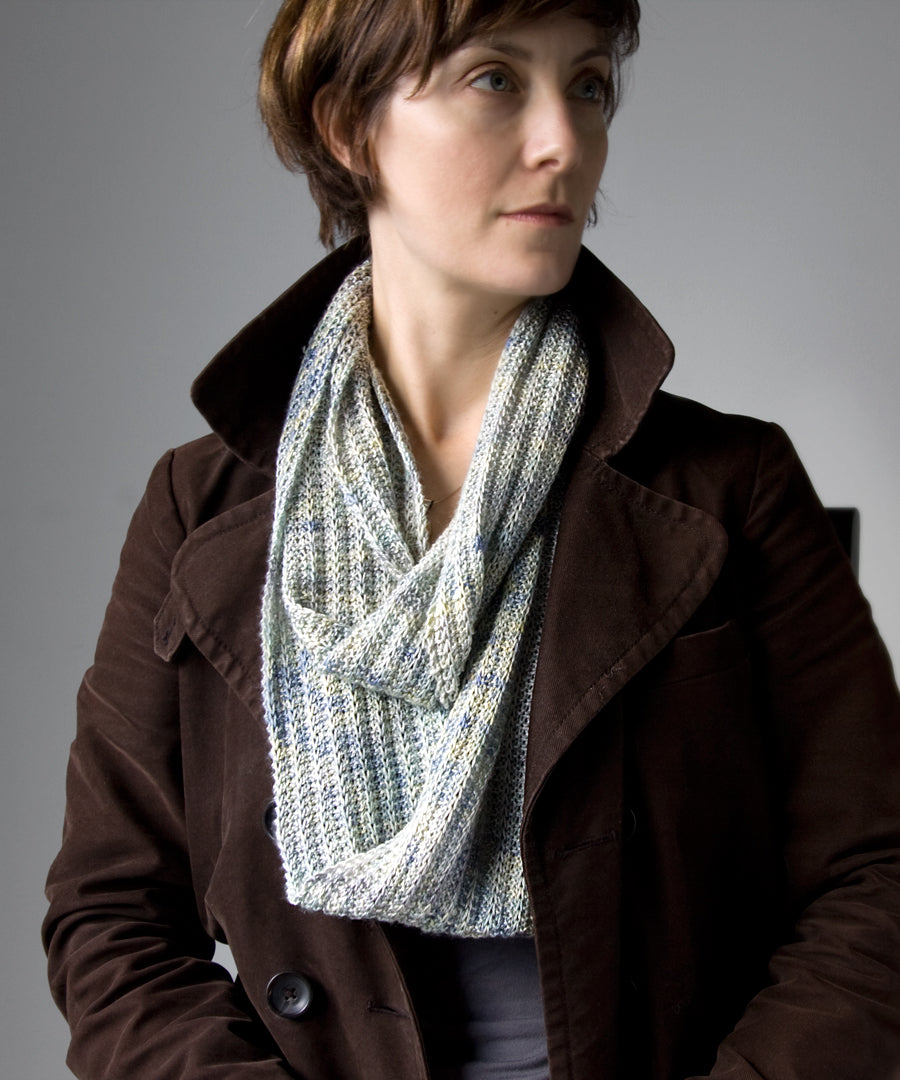
Opul is worked flat, end-to-end, from a provisional cast on and grafted. The rib pattern is a great introduction to using slipped stitches to create texture and elasticity in the simplest of stitch combinations. The pattern is easy to memorize and very easy to work. This is a great project for the beginner knitter who is ready for the challenge of a provisional cast on and a careful graft at the end. You can easily modify Opul by changing the yarn, the cast on or the number of rows.
Skill Level Easy-intermediate
Finished Measurements About 9" high x 64" around, after blocking
Yarn 2 skeins Sweatermaker Yarns Maggie 70% silk 30% cashmere, 251 yds (230 m)/50g per skein
Gauge 24 stitches and 32 rows = 4 inches/10cm in stockinette (stocking) stitch, blocked. Gauge is not essential for this project.
Needles 4.5mm (US 7) needles. Opul is worked on large needles to give the fabric extra drape
Other Supplies spare needle for grafting, blunt yarn needle, smooth yarn for provisional cast on, crochet hook
Construction Notes Opul is worked flat from a provisional cast on and grafted. To change the height of Opul, you can modify the cast on in multiples of 4. To change the circumference, simply work more or fewer rows. Opul would look great in almost any weight of yarn.
Tips for modifying To change the height of Opul, you can modify the cast on in multiples of 4. To change the circumference, simply work more or fewer rows. Opul would look great in almost any weight of yarn.
Scarf pattern
Using the Chain method, provisionally cast on 55 stitches, leaving a long tail for grafting.
Work in Cartridge Belt Rib until your scarf measures about 60" from the cast on edge (the scarf will stretch a bit on blocking), ending with Row 2. Do not bind off.
Finishing
With your spare needle, pick up 1 stitch at the yarn tail edge
of your provisional cast on, then transfer the stitches from
the provisional cast on to the needle. You should now have 56 stitches. Arrange your work for grafting with the cast on edge on the back needle with the yarn tail on the right, and the other needle with your final row worked at the front. Thread the yarn tail through a blunt yarn needle.
Graft using Kitchener Stitch.
Your graft will be slightly visible on one side. As you work, make sure your vertical slip-stitch ridges are lining up.
Block and weave in ends.
Special Stitch Patterns and Techniques
Cartridge Belt Rib (multiple of 4 plus 3 stitches)
This stitch pattern is featured in Barbara Walker's Second Treasury of Knitting Patterns. I love her description, "This pattern makes simple but beautiful borders, well-mannered sportswear, and easy-to-knit afghans." The stitch pattern is reversible, but the instructions treat odd-numbered rows as WS rows.
Row 1 (WS): K1, *slip 1 purlwise with yarn in front, k3; repeat from *, ending k1 instead of k3.
Row 2 (RS): K3, *slip 1 purlwise with yarn in front, k3; repeat from * to end.
Provisional Cast On - Chain method
With crochet hook and smooth scrap yarn, make a chain about 5 stitches longer than your cast on. With working yarn and knitting needle, pick up and knit into the back bump of each crocheted stitch until you have the required number of stitches on your needle.
Kitchener Stitch in pattern
*
3 times (knitwise graft)
Thread through the front stitch as if to purl, leave stitch on. Thread through the back stitch as if to purl, slide stitch off. Thread through the back stitch as if to knit, leave stitch on. Thread through the front stitch as if to knit, slide stitch off.
1 time (purlwise graft)
Thread through the front stitch as if to knit, leave stitch on. Thread through the back stitch as if to knit, slide stitch off. Thread through the back stitch as if to purl, leave stitch on. Thread through the front stitch as if to purl, slide stitch off.
Repeat from * until all stitches are off
To learn more about grafting in pattern, I suggest Joni Coniglio's article The Ins and Outs of Grafting in Interweave Press knit.wear premiere 2011 edition.
